quizforge / gallery / ch101-demo
Quiz 3 — Stoichiometry & Periodicity
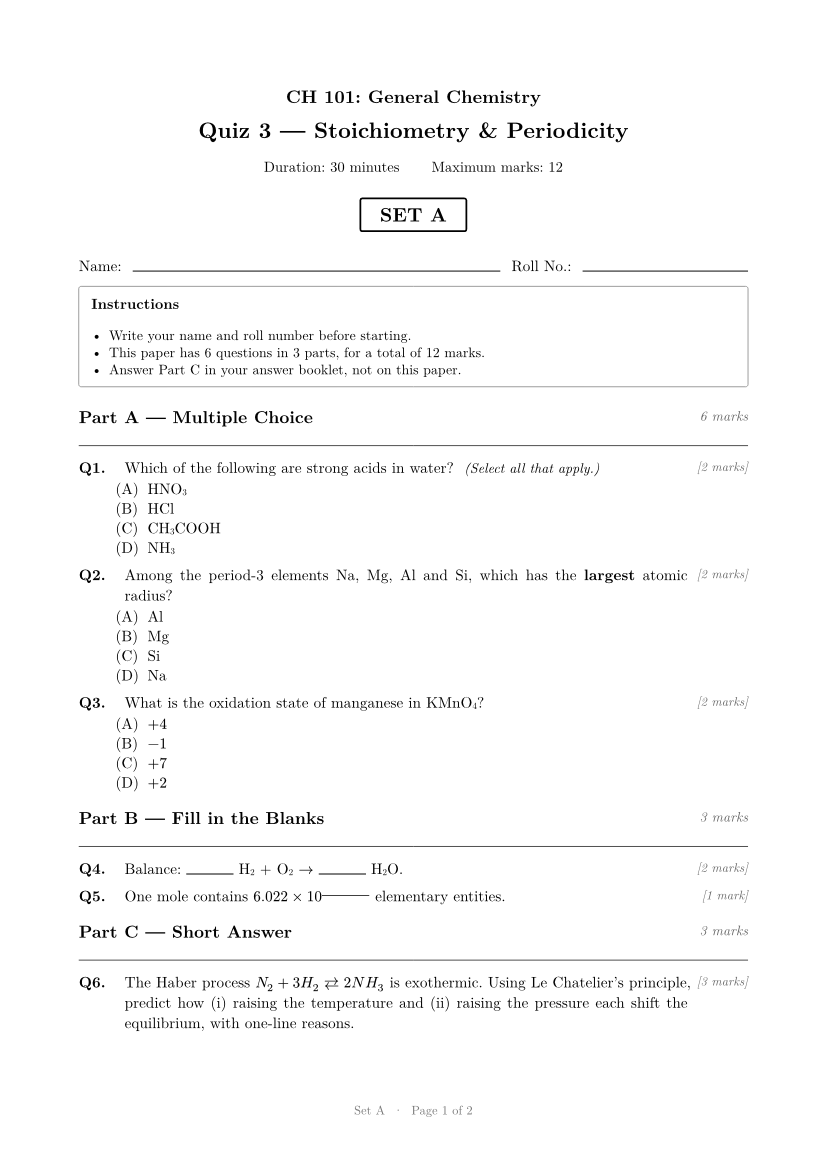
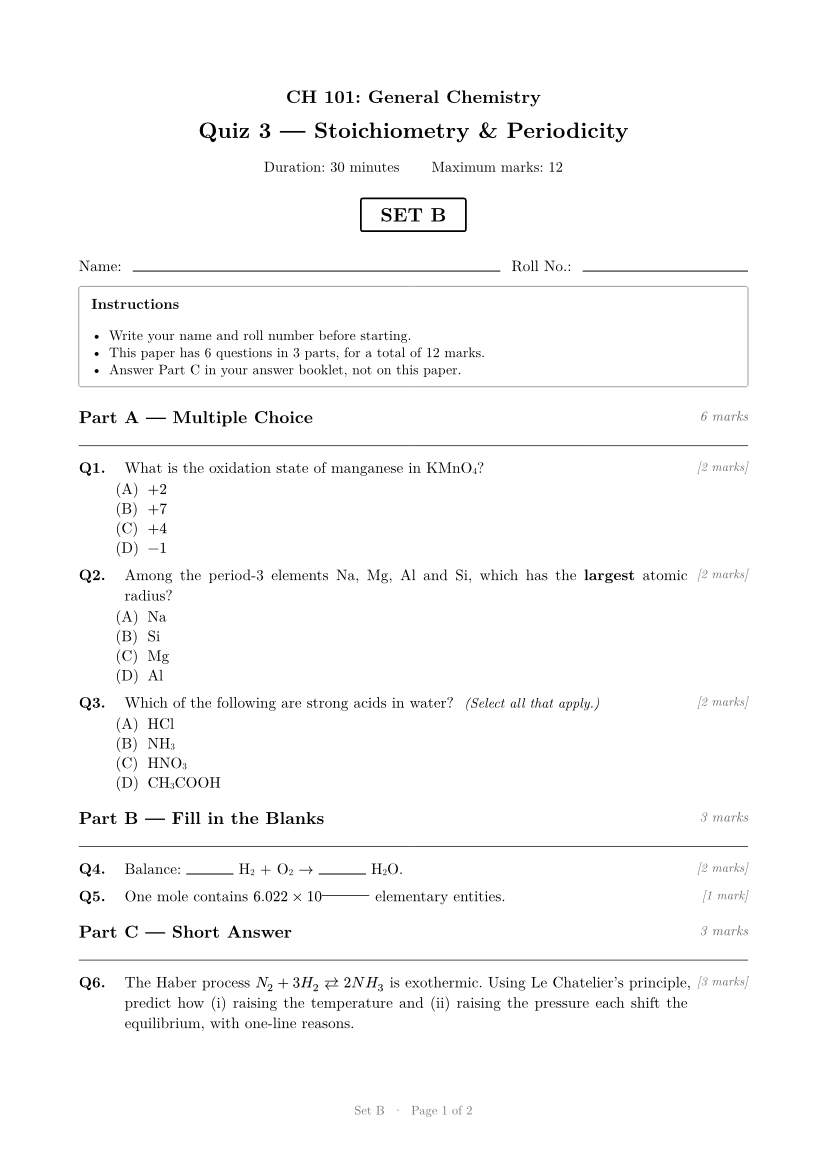
Molecular formulas, two-blank equation balancing, booklet-mode Part C (no answer space). Every set below contains exactly the same questions and total marks — only the question order and the MCQ option order differ, derived deterministically from the exam id and the set id.
The 2 versions
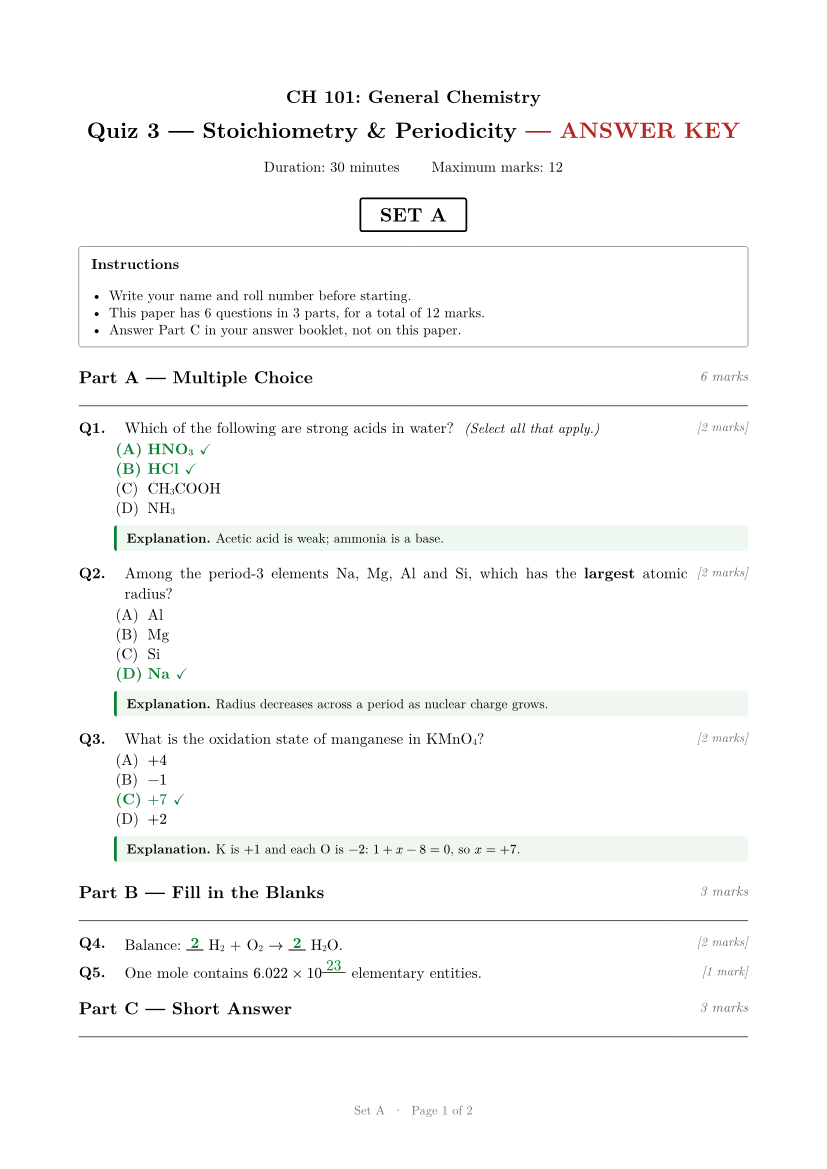
Answer key (set A)
The source that generated all of this
One file produces every version above, its keys, and the grading CSV. The feature tour explains each marker with minimal code.
View exams/demo-chemistry.typ (57 lines)
// Subject demo: general chemistry — molecular formulas, a two-blank balancing
// question, multi-select, periodic trends.

#import "/quizforge/lib.typ": *

#show: quiz.with(
  id: "ch101-demo",
  course: "CH 101: General Chemistry",
  title: "Quiz 3 — Stoichiometry & Periodicity",
  duration: "30 minutes",
  sets: ("A", "B"),
  instructions: ([Answer Part C in your answer booklet, not on this paper.],),
)

= Multiple Choice

+ #m(2) What is the oxidation state of manganese in KMnO#sub[4]?
  - ✓ $+7$
  - $+2$
  - $+4$
  - $-1$
  #explain[K is $+1$ and each O is $-2$: $1 + x - 8 = 0$, so $x = +7$.]

+ #m(2) Which of the following are strong acids in water?
  - ✓ HCl
  - ✓ HNO#sub[3]
  - CH#sub[3]COOH
  - NH#sub[3]
  #explain[Acetic acid is weak; ammonia is a base.]

+ #m(2) Among the period-3 elements Na, Mg, Al and Si, which has the *largest*
  atomic radius?
  - ✓ Na
  - Mg
  - Al
  - Si
  #explain[Radius decreases across a period as nuclear charge grows.]

= Fill in the Blanks

+ #m(2) Balance: #blank(width: 1.2cm)[2] H#sub[2] + O#sub[2] $arrow.r$
  #blank(width: 1.2cm)[2] H#sub[2]O.

+ #m(1) One mole contains $6.022 times 10^(#blank(width: 1.2cm)[$23$])$
  elementary entities.

= Short Answer

+ #m(3) The Haber process $N_2 + 3 H_2 arrows.rl 2 N H_3$ is exothermic.
  Using Le Chatelier's principle, predict how (i) raising the temperature and
  (ii) raising the pressure each shift the equilibrium, with one-line reasons.
  #answer(none, rubric: [+1.5 temperature: shifts left (heat is a product);
    +1.5 pressure: shifts right (4 gas moles → 2).])[
    (i) Heating shifts the equilibrium left — the reverse (endothermic)
    direction absorbs the added heat. (ii) Compression shifts it right, toward
    fewer moles of gas (4 → 2), reducing pressure.]