quizforge / gallery / cs201-demo
Quiz 1 — Complexity & Sorting
Code traces, a true/false pair, master-theorem recurrences, two-column options. Every set below contains exactly the same questions and total marks — only the question order and the MCQ option order differ, derived deterministically from the exam id and the set id.
The 2 versions
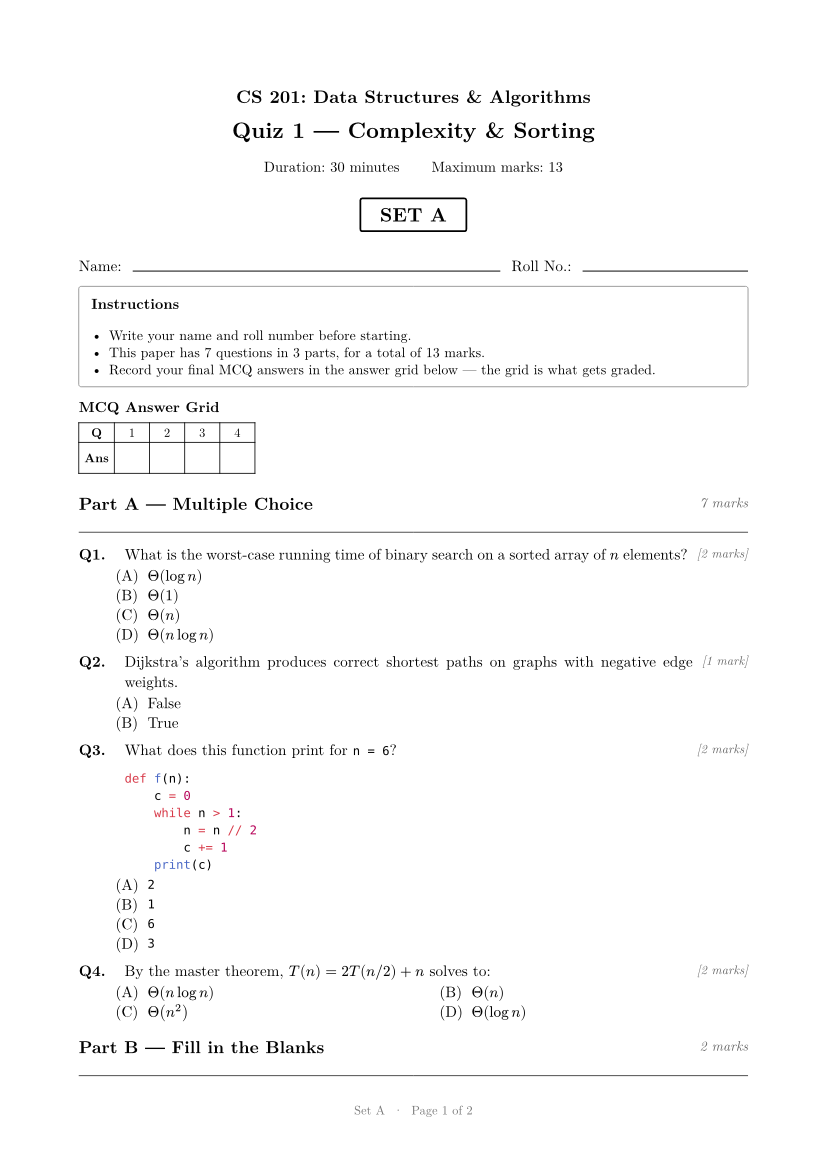
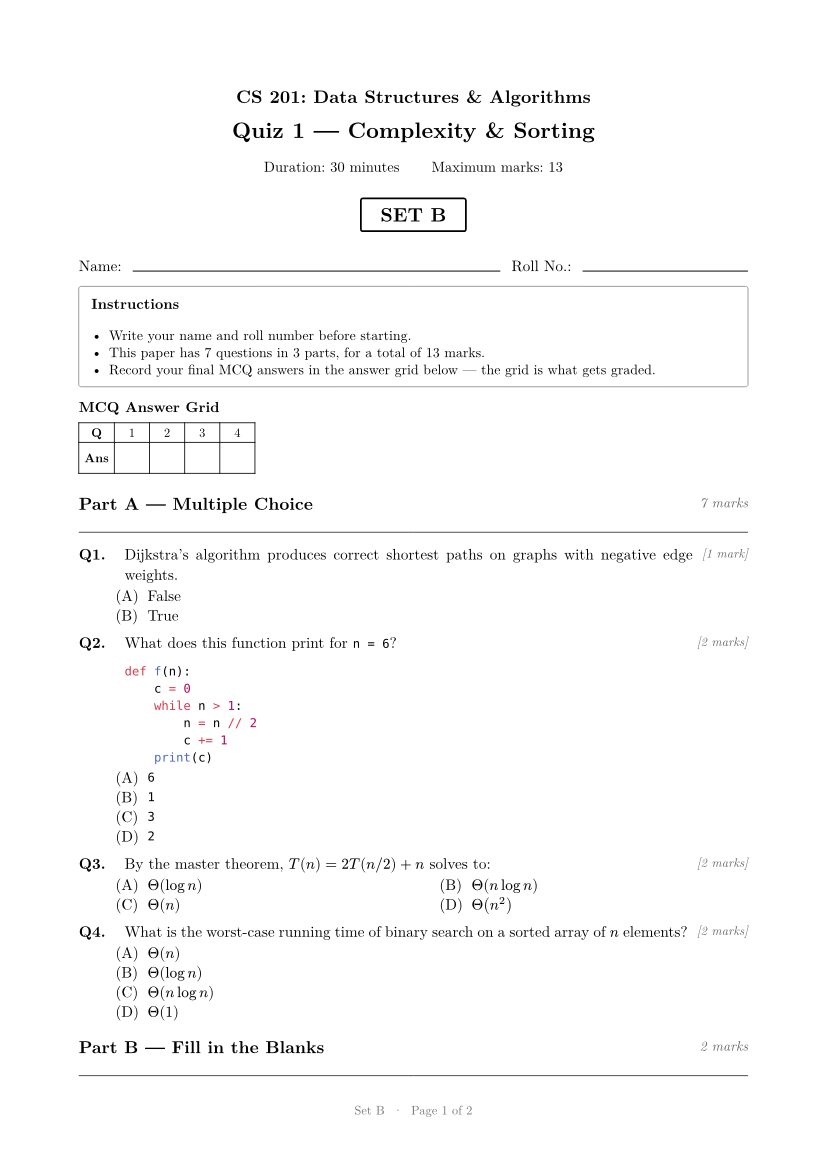
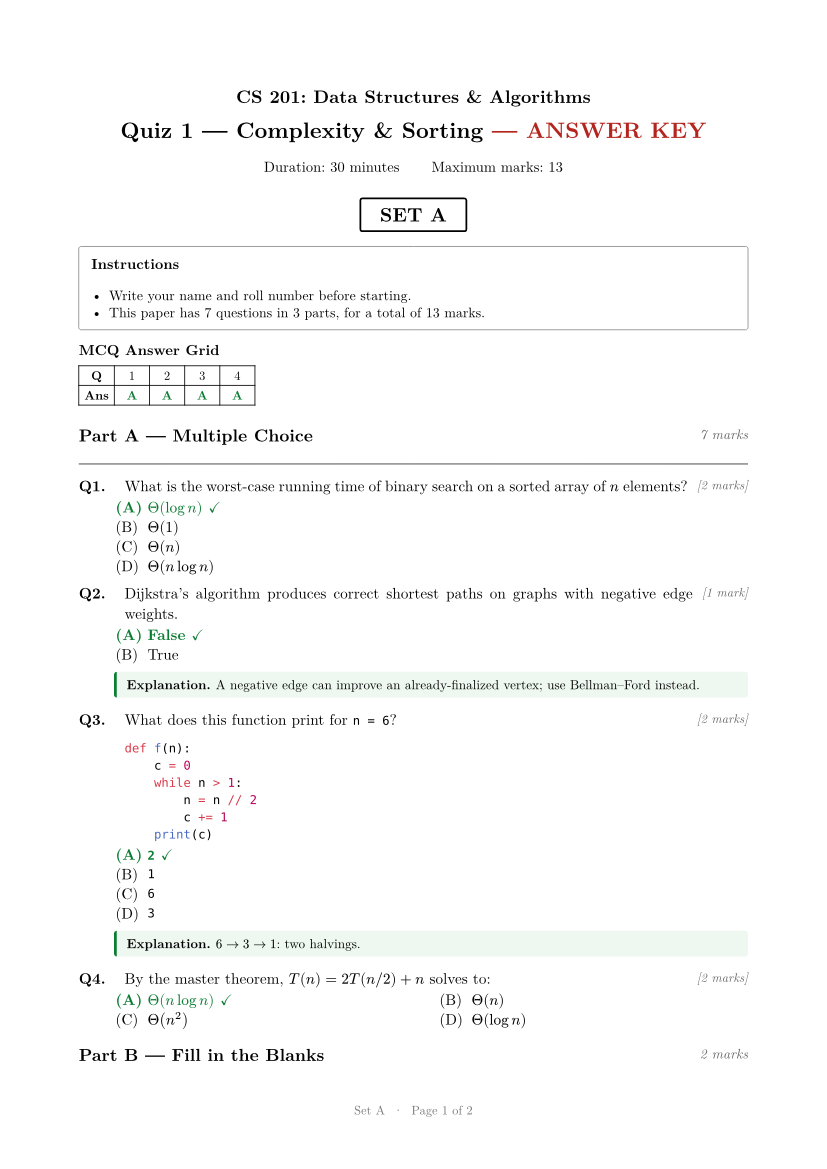
Answer key (set A)
The source that generated all of this
One file produces every version above, its keys, and the grading CSV. The feature tour explains each marker with minimal code.
View exams/demo-algorithms.typ (71 lines)
// Subject demo: algorithms — code blocks, a trace question, true/false,
// two-column options, a lower-bound proof.

#import "/quizforge/lib.typ": *

#show: quiz.with(
  id: "cs201-demo",
  course: "CS 201: Data Structures & Algorithms",
  title: "Quiz 1 — Complexity & Sorting",
  duration: "30 minutes",
  sets: ("A", "B"),
  answer-grid: true,
)

= Multiple Choice

+ #m(2) What is the worst-case running time of binary search on a sorted array
  of $n$ elements?
  - ✓ $Theta(log n)$
  - $Theta(n)$
  - $Theta(n log n)$
  - $Theta(1)$

+ #m(2) What does this function print for `n = 6`?
  ```python
  def f(n):
      c = 0
      while n > 1:
          n = n // 2
          c += 1
      print(c)
  ```
  - ✓ `2`
  - `3`
  - `6`
  - `1`
  #explain[$6 arrow.r 3 arrow.r 1$: two halvings.]

+ #m(1) Dijkstra's algorithm produces correct shortest paths on graphs with
  negative edge weights.
  - True
  - ✓ False
  #explain[A negative edge can improve an already-finalized vertex;
    use Bellman–Ford instead.]

+ #m(2) #opts(columns: 2) By the master theorem, $T(n) = 2 T(n\/2) + n$ solves to:
  - $Theta(n)$
  - ✓ $Theta(n log n)$
  - $Theta(n^2)$
  - $Theta(log n)$

= Fill in the Blanks

+ #m(1) A sorting algorithm is *stable* if it preserves the relative order of
  #blank(width: 2cm)[equal] keys.

+ #m(1) The average-case running time of quicksort with uniformly random
  pivots is $Theta(#blank(width: 2cm)[$n log n$])$.

= Short Answer

+ #m(4) Sketch the decision-tree argument that any comparison-based sorting
  algorithm needs $Omega(n log n)$ comparisons in the worst case.
  #answer(6cm, rubric: [+1 model: binary decision tree, leaves = permutations;
    +1 at least $n!$ leaves; +1 height $>= log_2 n!$; +1 Stirling
    → $Omega(n log n)$.])[
    Any comparison sort is a binary decision tree whose leaves are the $n!$
    input permutations. A binary tree with $n!$ leaves has height at least
    $log_2 n! = Theta(n log n)$ (Stirling), so some input forces that many
    comparisons.]