quizforge / gallery / ph101-demo
Quiz 2 — Kinematics & Momentum
Projectile figure, unit-heavy numerics, a kinematics derivation. Every set below contains exactly the same questions and total marks — only the question order and the MCQ option order differ, derived deterministically from the exam id and the set id.
The 2 versions
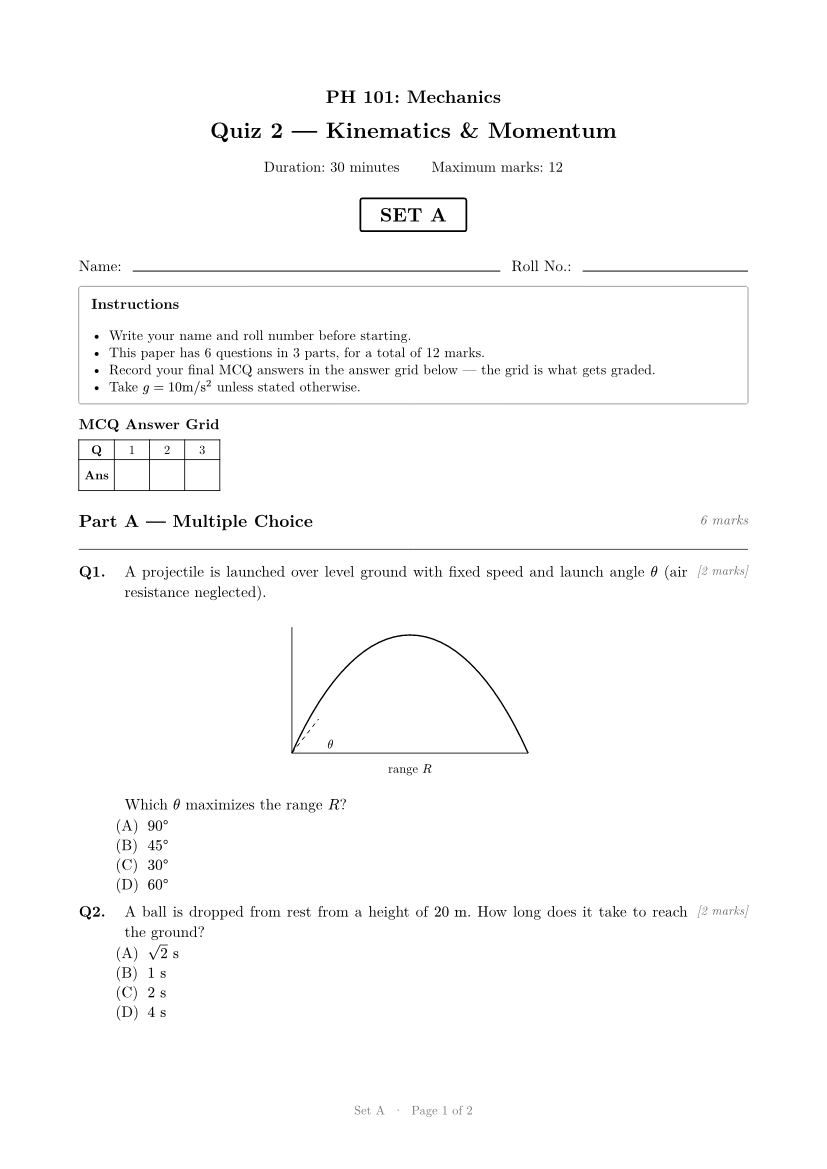
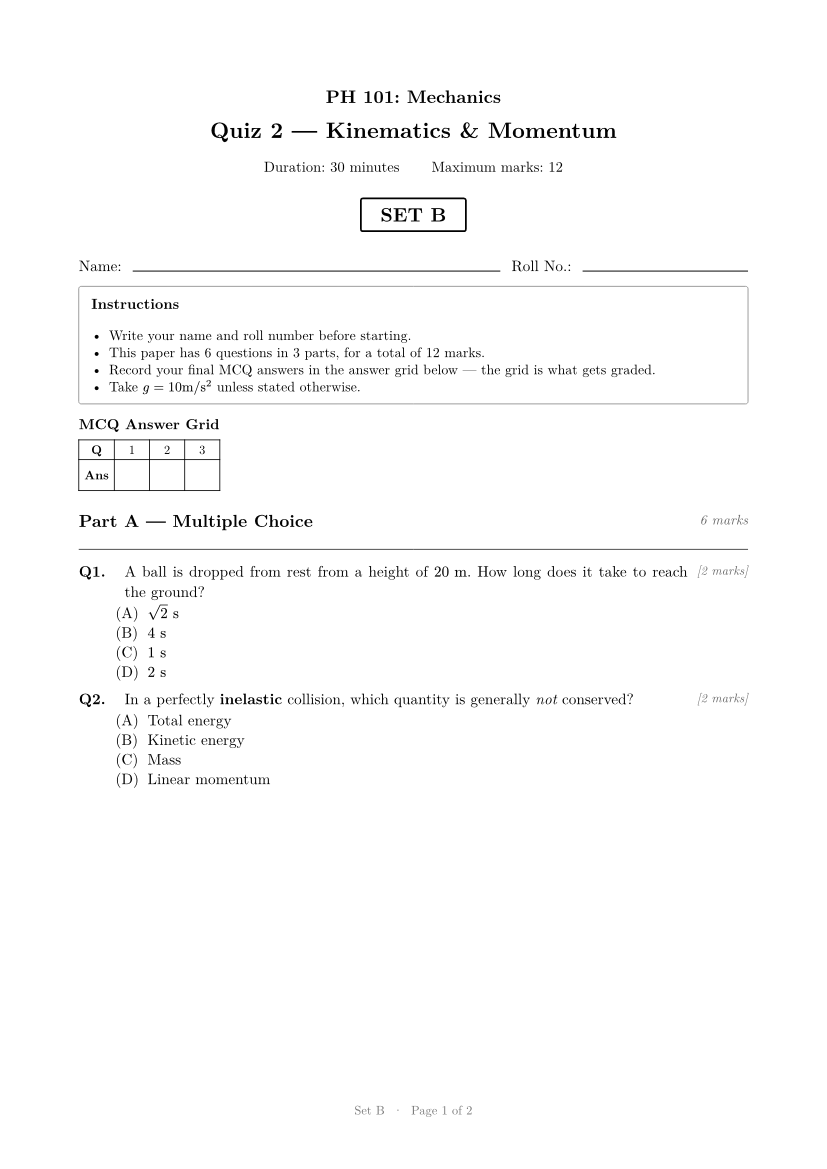
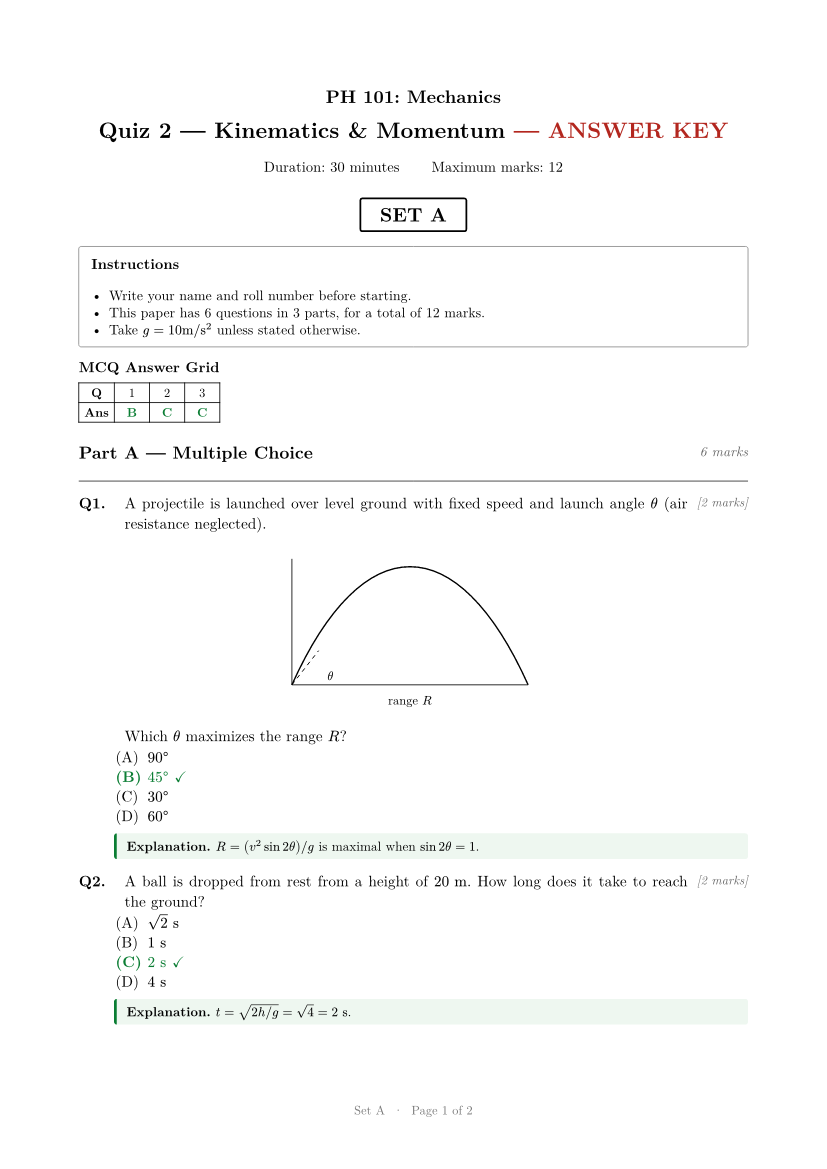
Answer key (set A)
The source that generated all of this
One file produces every version above, its keys, and the grading CSV. The feature tour explains each marker with minimal code.
View exams/demo-physics.typ (75 lines)
// Subject demo: introductory mechanics — units, numerics, a projectile figure.

#import "/quizforge/lib.typ": *

#let trajectory-fig = {
  let w = 6cm
  let h = 3.2cm
  align(center, box(width: w + 1.2cm, height: h + 1cm, inset: (left: 0.7cm, bottom: 0.7cm, top: 0.3cm, right: 0.5cm), {
    place(bottom + left, line(length: w, stroke: 0.6pt))
    place(bottom + left, line(angle: -90deg, length: h, stroke: 0.6pt))
    place(bottom + left, curve(
      stroke: 1pt,
      curve.move((0cm, 0cm)),
      curve.cubic((w * 0.3, -h * 1.25), (w * 0.7, -h * 1.25), (w, 0cm)),
    ))
    place(bottom + left, dx: 0.9cm, dy: -0.12cm, text(size: 9pt, [$theta$]))
    place(bottom + left, line(angle: -52deg, length: 1.1cm, stroke: (thickness: 0.7pt, dash: "dashed")))
    place(bottom + center, dy: 0.5cm, text(size: 9pt, [range $R$]))
  }))
}

#show: quiz.with(
  id: "ph101-demo",
  course: "PH 101: Mechanics",
  title: "Quiz 2 — Kinematics & Momentum",
  duration: "30 minutes",
  sets: ("A", "B"),
  answer-grid: true,
  instructions: ([Take $g = 10 "m/s"^2$ unless stated otherwise.],),
)

= Multiple Choice

+ #m(2) A projectile is launched over level ground with fixed speed and launch
  angle $theta$ (air resistance neglected).
  #trajectory-fig
  Which $theta$ maximizes the range $R$?
  - ✓ $45 degree$
  - $30 degree$
  - $60 degree$
  - $90 degree$
  #explain[$R = (v^2 sin 2theta) \/ g$ is maximal when $sin 2theta = 1$.]

+ #m(2) A ball is dropped from rest from a height of $20 "m"$. How long does it
  take to reach the ground?
  - ✓ $2 "s"$
  - $4 "s"$
  - $1 "s"$
  - $sqrt(2) "s"$
  #explain[$t = sqrt(2h\/g) = sqrt(4) = 2 "s"$.]

+ #m(2) In a perfectly *inelastic* collision, which quantity is generally
  #emph[not] conserved?
  - ✓ Kinetic energy
  - Linear momentum
  - Total energy
  - Mass

= Fill in the Blanks

+ #m(1) "For every action there is an equal and opposite reaction" is Newton's
  #blank(width: 1.8cm)[third] law.

+ #m(1) The SI unit of power is the #blank[watt], equal to one joule per second.

= Short Answer

+ #m(4) Starting from $v = u + a t$ and $s = u t + 1/2 a t^2$, derive
  $v^2 = u^2 + 2 a s$.
  #answer(6cm, rubric: [+1 solve first equation for $t$; +2 substitution;
    +1 algebra to the final form.])[
    From the first equation $t = (v - u)\/a$. Substituting,
    $s = u (v - u)\/a + 1/2 a ((v - u)\/a)^2 = (v^2 - u^2)\/(2a)$,
    hence $v^2 = u^2 + 2 a s$.]