quizforge / gallery / ma102-demo
Quiz 2 — Determinants & Eigenvalues
Matrices, a multi-select on invertibility, an eigenvalue proof with rubric. Every set below contains exactly the same questions and total marks — only the question order and the MCQ option order differ, derived deterministically from the exam id and the set id.
The 2 versions
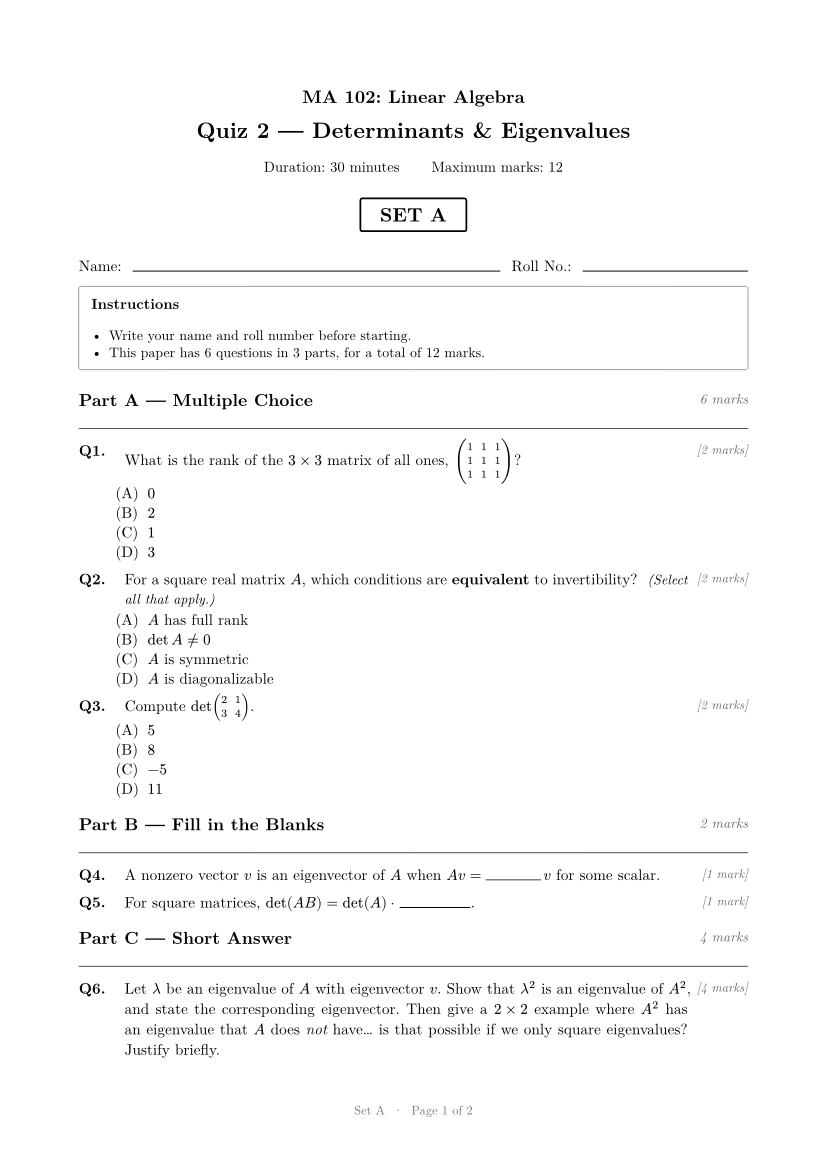
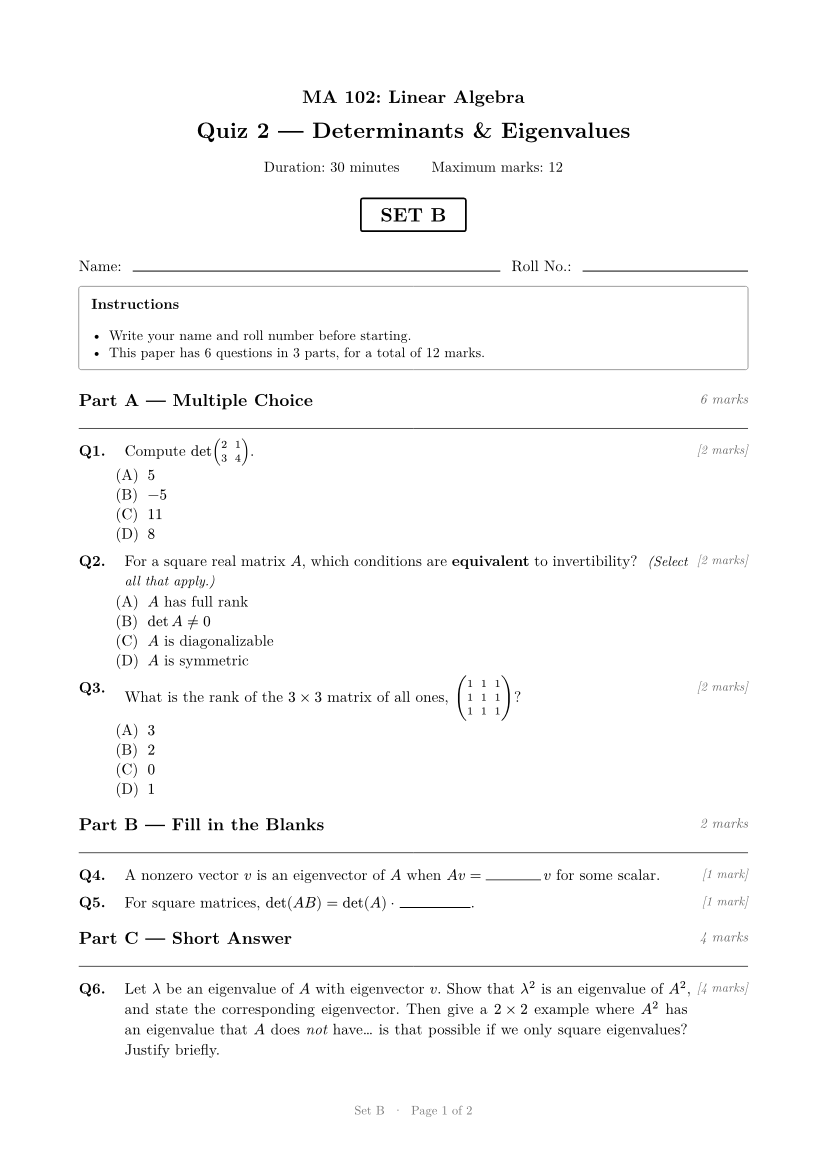
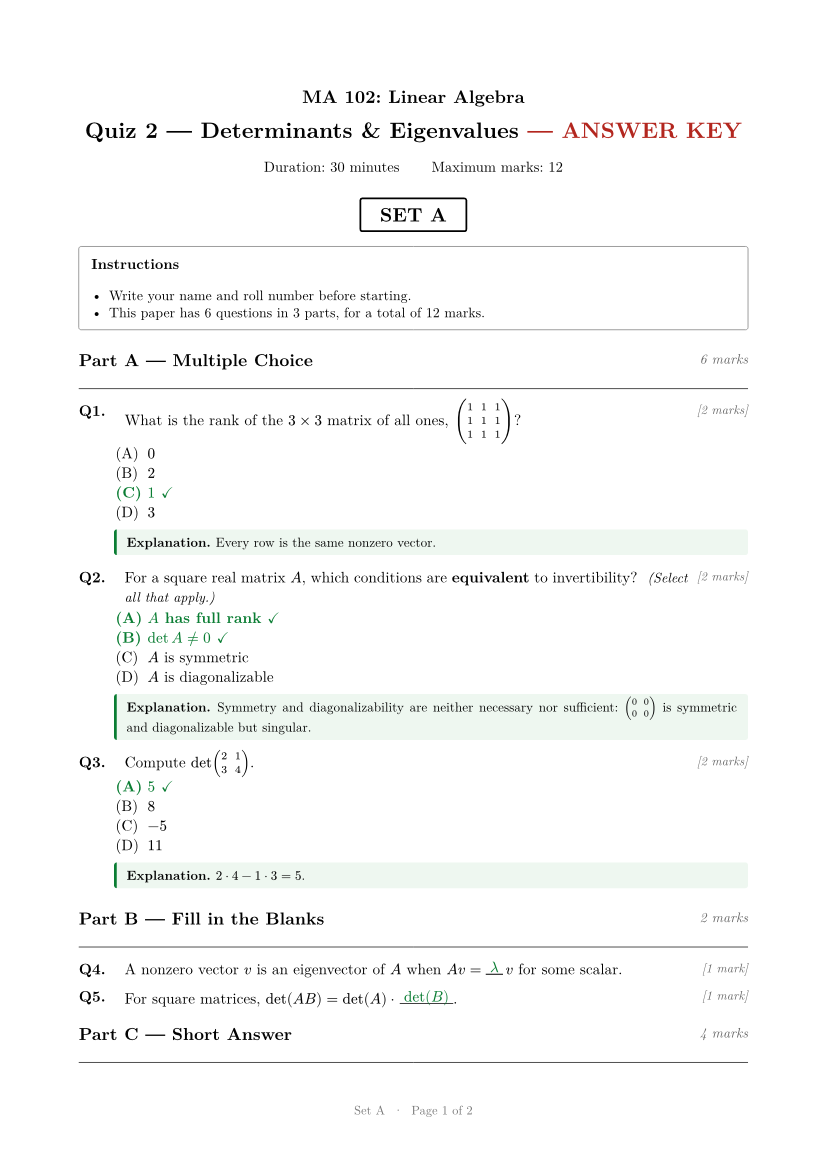
Answer key (set A)
The source that generated all of this
One file produces every version above, its keys, and the grading CSV. The feature tour explains each marker with minimal code.
View exams/demo-linear-algebra.typ (62 lines)
// Subject demo: linear algebra — matrices via mat(), multi-select on
// invertibility, an eigenvalue proof with model answer.

#import "/quizforge/lib.typ": *

#show: quiz.with(
  id: "ma102-demo",
  course: "MA 102: Linear Algebra",
  title: "Quiz 2 — Determinants & Eigenvalues",
  duration: "30 minutes",
  sets: ("A", "B"),
)

= Multiple Choice

+ #m(2) Compute $det mat(2, 1; 3, 4)$.
  - ✓ $5$
  - $11$
  - $-5$
  - $8$
  #explain[$2 dot 4 - 1 dot 3 = 5$.]

+ #m(2) What is the rank of the $3 times 3$ matrix of all ones,
  $mat(1, 1, 1; 1, 1, 1; 1, 1, 1)$?
  - ✓ $1$
  - $0$
  - $2$
  - $3$
  #explain[Every row is the same nonzero vector.]

+ #m(2) For a square real matrix $A$, which conditions are *equivalent* to
  invertibility?
  - ✓ $det A != 0$
  - ✓ $A$ has full rank
  - $A$ is symmetric
  - $A$ is diagonalizable
  #explain[Symmetry and diagonalizability are neither necessary nor
    sufficient: $mat(0, 0; 0, 0)$ is symmetric and diagonalizable but singular.]

= Fill in the Blanks

+ #m(1) A nonzero vector $v$ is an eigenvector of $A$ when
  $A v = #blank(width: 1.4cm)[$lambda$] thin v$ for some scalar.

+ #m(1) For square matrices, $det(A B) = det(A) dot$
  #blank(width: 1.8cm)[$det(B)$].

= Short Answer

+ #m(4) Let $lambda$ be an eigenvalue of $A$ with eigenvector $v$. Show that
  $lambda^2$ is an eigenvalue of $A^2$, and state the corresponding
  eigenvector. Then give a $2 times 2$ example where $A^2$ has an eigenvalue
  that $A$ does #emph[not] have... is that possible if we only square
  eigenvalues? Justify briefly.
  #answer(7cm, rubric: [+2 the computation $A^2 v = lambda^2 v$; +1 eigenvector
    is the same $v$; +1 justification that eigenvalues of $A^2$ are exactly
    squares of eigenvalues of $A$ (over $CC$), so no new ones appear.])[
    $A^2 v = A(A v) = A(lambda v) = lambda (A v) = lambda^2 v$, so $lambda^2$
    is an eigenvalue with the *same* eigenvector $v$. Over $CC$ every
    eigenvalue of $A^2$ is the square of an eigenvalue of $A$ (triangularize),
    so squaring cannot create eigenvalues unrelated to those of $A$.]