For a real model, we’d use datasets like Alpaca, Dolly, or OpenAssistant. For our educational purposes, we’ll create a small synthetic dataset.
# Our expanded instruction dataset with Python Q&Ainstruction_data = [# === GENERAL Q&A === {"instruction": "What is the capital of France?", "response": "The capital of France is Paris."}, {"instruction": "What is the capital of India?", "response": "The capital of India is New Delhi."}, {"instruction": "What is the capital of Japan?", "response": "The capital of Japan is Tokyo."}, {"instruction": "What is the capital of Germany?", "response": "The capital of Germany is Berlin."}, {"instruction": "What is the capital of Italy?", "response": "The capital of Italy is Rome."}, {"instruction": "What is the capital of Spain?", "response": "The capital of Spain is Madrid."}, {"instruction": "What is the capital of China?", "response": "The capital of China is Beijing."}, {"instruction": "What is the capital of Brazil?", "response": "The capital of Brazil is Brasilia."},# Math {"instruction": "What is 2 + 2?", "response": "2 + 2 equals 4."}, {"instruction": "What is 5 * 3?", "response": "5 * 3 equals 15."}, {"instruction": "What is 10 - 7?", "response": "10 - 7 equals 3."}, {"instruction": "What is 20 / 4?", "response": "20 / 4 equals 5."}, {"instruction": "What is 3 + 3?", "response": "3 + 3 equals 6."}, {"instruction": "What is 7 * 8?", "response": "7 * 8 equals 56."}, {"instruction": "What is 100 / 10?", "response": "100 / 10 equals 10."},# Basic instructions {"instruction": "Say hello.", "response": "Hello! How can I help you today?"}, {"instruction": "Count to five.", "response": "1, 2, 3, 4, 5."}, {"instruction": "Count to three.", "response": "1, 2, 3."}, {"instruction": "Name three colors.", "response": "Red, blue, and green."}, {"instruction": "List three fruits.", "response": "Apple, banana, and orange."}, {"instruction": "Name three animals.", "response": "Dog, cat, and elephant."}, {"instruction": "List three countries.", "response": "USA, India, and Japan."},# General knowledge {"instruction": "Who wrote Romeo and Juliet?", "response": "William Shakespeare wrote Romeo and Juliet."}, {"instruction": "What planet is closest to the sun?", "response": "Mercury is the planet closest to the sun."}, {"instruction": "How many days are in a week?", "response": "There are 7 days in a week."}, {"instruction": "What is H2O?", "response": "H2O is the chemical formula for water."}, {"instruction": "How many hours in a day?", "response": "There are 24 hours in a day."}, {"instruction": "How many months in a year?", "response": "There are 12 months in a year."},# === PYTHON BASICS === {"instruction": "What is Python?", "response": "Python is a popular programming language known for its simplicity and readability."}, {"instruction": "How do I print Hello World in Python?", "response": "Use print('Hello World') to print Hello World in Python."}, {"instruction": "What is a variable in Python?", "response": "A variable is a name that stores a value. Example: x = 5 stores 5 in x."}, {"instruction": "How do I create a list in Python?", "response": "Create a list with square brackets: my_list = [1, 2, 3]"}, {"instruction": "What is a function in Python?", "response": "A function is reusable code defined with def. Example: def greet(): print('Hi')"}, {"instruction": "How do I define a function in Python?", "response": "Use def keyword: def my_function(): followed by indented code."}, {"instruction": "What is a loop in Python?", "response": "A loop repeats code. Use for to iterate: for i in range(5): print(i)"}, {"instruction": "How do I use a for loop?", "response": "for item in collection: then indented code. Example: for i in range(3): print(i)"}, {"instruction": "What is an if statement?", "response": "An if statement runs code conditionally: if x > 5: print('big')"}, {"instruction": "How do I check if a number is even?", "response": "Use modulo: if num % 2 == 0: the number is even."}, {"instruction": "What is a string in Python?", "response": "A string is text in quotes: name = 'Python' or name = \"Python\""}, {"instruction": "How do I get the length of a list?", "response": "Use len(): length = len(my_list) returns the number of items."}, {"instruction": "What is a dictionary in Python?", "response": "A dictionary stores key-value pairs: d = {'name': 'John', 'age': 25}"}, {"instruction": "How do I add to a list?", "response": "Use append(): my_list.append(4) adds 4 to the end of my_list."}, {"instruction": "What is range() in Python?", "response": "range(n) generates numbers 0 to n-1. range(5) gives 0,1,2,3,4."}, {"instruction": "How do I read a file in Python?", "response": "Use open(): with open('file.txt', 'r') as f: content = f.read()"}, {"instruction": "What is a class in Python?", "response": "A class is a blueprint for objects: class Dog: def bark(self): print('Woof')"}, {"instruction": "How do I handle errors in Python?", "response": "Use try/except: try: risky_code() except: handle_error()"}, {"instruction": "What is None in Python?", "response": "None represents no value or null. Example: x = None"}, {"instruction": "How do I convert string to int?", "response": "Use int(): num = int('42') converts string '42' to integer 42."}, {"instruction": "What is a tuple in Python?", "response": "A tuple is immutable list: t = (1, 2, 3) cannot be changed after creation."}, {"instruction": "How do I join strings?", "response": "Use + or join: 'Hello' + ' World' or ' '.join(['Hello', 'World'])"}, {"instruction": "What is import in Python?", "response": "import loads a module: import math then use math.sqrt(16) for square root."}, {"instruction": "How do I create a set?", "response": "Use curly braces: s = {1, 2, 3} creates a set with unique values."}, {"instruction": "What is self in Python?", "response": "self refers to the current object instance in a class method."}, {"instruction": "How do I reverse a list?", "response": "Use reverse() method: my_list.reverse() or my_list[::-1] for new list."}, {"instruction": "What is pip?", "response": "pip is Python's package manager. Use pip install package_name to install."}, {"instruction": "How do I check Python version?", "response": "Run python --version in terminal or import sys; print(sys.version)"}, {"instruction": "What is a boolean?", "response": "Boolean is True or False. Used in conditions: if is_valid: do_something()"}, {"instruction": "How do I sort a list?", "response": "Use sort(): my_list.sort() or sorted(my_list) for new sorted list."},# === PYTHON DATA TYPES === {"instruction": "What data types exist in Python?", "response": "Python has int, float, str, list, dict, tuple, set, bool, and None."}, {"instruction": "What is the difference between list and tuple?", "response": "Lists are mutable (changeable), tuples are immutable (fixed after creation)."}, {"instruction": "How do I check type of a variable?", "response": "Use type(): type(x) returns the type, like <class 'int'> or <class 'str'>"}, {"instruction": "What is a float in Python?", "response": "A float is a decimal number: x = 3.14 or y = 2.0"},# === ALGORITHMS === {"instruction": "What is an algorithm?", "response": "An algorithm is a step-by-step procedure for solving a problem or task."}, {"instruction": "What is Big O notation?", "response": "Big O describes algorithm efficiency. O(1) is constant, O(n) is linear time."}, {"instruction": "What is a sorting algorithm?", "response": "A sorting algorithm arranges items in order. Examples: bubble sort, quicksort."}, {"instruction": "What is recursion?", "response": "Recursion is when a function calls itself. Needs a base case to stop."}, {"instruction": "What is binary search?", "response": "Binary search finds items in sorted list by halving. O(log n) time."},# === MACHINE LEARNING === {"instruction": "What is machine learning?", "response": "Machine learning is AI where computers learn patterns from data to make predictions."}, {"instruction": "What is deep learning?", "response": "Deep learning uses neural networks with many layers to learn complex patterns."}, {"instruction": "What is a neural network?", "response": "A neural network is layers of connected nodes that learn from data."}, {"instruction": "What is training in ML?", "response": "Training is teaching a model by showing it examples and adjusting weights."}, {"instruction": "What is overfitting?", "response": "Overfitting is when a model memorizes training data but fails on new data."}, {"instruction": "What is a loss function?", "response": "A loss function measures how wrong predictions are. Training minimizes it."}, {"instruction": "What is PyTorch?", "response": "PyTorch is a Python library for deep learning with dynamic computation graphs."}, {"instruction": "What is a tensor?", "response": "A tensor is a multi-dimensional array, like a matrix but with more dimensions."}, {"instruction": "What is backpropagation?", "response": "Backpropagation computes gradients to update weights during training."}, {"instruction": "What is a learning rate?", "response": "Learning rate controls how much to adjust weights. Too high = unstable, too low = slow."},]print(f"Number of instruction-response pairs: {len(instruction_data)}")print(f"Categories covered: General Q&A, Math, Python basics, Data types, Algorithms, ML")
Number of instruction-response pairs: 77
Categories covered: General Q&A, Math, Python basics, Data types, Algorithms, ML
Step 2: Format for Training
We need a consistent format that the model can learn. A common format is:
def format_example(example):"""Format an instruction-response pair for training."""returnf"""### Instruction:{example['instruction']}### Response:{example['response']}<|endoftext|>"""# Preview formattingprint("Example formatted training data:")print("="*50)print(format_example(instruction_data[0]))print("="*50)print(format_example(instruction_data[5]))
Example formatted training data:
==================================================
### Instruction:
What is the capital of France?

### Response:
The capital of France is Paris.<|endoftext|>
==================================================
### Instruction:
What is the capital of Spain?

### Response:
The capital of Spain is Madrid.<|endoftext|>
# Create training texttraining_text ="\n\n".join(format_example(ex) for ex in instruction_data)print(f"Total training characters: {len(training_text)}")print(f"\nFirst 500 characters:")print(training_text[:500])
Total training characters: 9646

First 500 characters:
### Instruction:
What is the capital of France?

### Response:
The capital of France is Paris.<|endoftext|>

### Instruction:
What is the capital of India?

### Response:
The capital of India is New Delhi.<|endoftext|>

### Instruction:
What is the capital of Japan?

### Response:
The capital of Japan is Tokyo.<|endoftext|>

### Instruction:
What is the capital of Germany?

### Response:
The capital of Germany is Berlin.<|endoftext|>

### Instruction:
What is the capital of Italy?

### Response:
Step 3: Build Vocabulary and Dataset
# Build vocabulary from training datachars =sorted(set(training_text))stoi = {ch: i for i, ch inenumerate(chars)}itos = {i: ch for ch, i in stoi.items()}vocab_size =len(stoi)print(f"Vocabulary size: {vocab_size}")print(f"Characters: {''.join(chars[:50])}...")
# Encode training data with SMALLER block sizeblock_size =64# Reduced from 128 for speeddef build_dataset(text, block_size, stoi): data = [stoi[ch] for ch in text] X, Y = [], []for i inrange(len(data) - block_size): X.append(data[i:i + block_size]) Y.append(data[i +1:i + block_size +1])return torch.tensor(X), torch.tensor(Y)X, Y = build_dataset(training_text, block_size, stoi)print(f"Training examples: {len(X)} (small block size for fast demo)")
Training examples: 9582 (small block size for fast demo)
Step 4: Model Architecture
We’ll use the transformer from Part 4, but with a twist: we’ll initialize with pretrained weights in a real scenario. For simplicity, we’ll train from scratch on our small dataset.
# Create model with REDUCED capacity for fast demod_model =128# Reduced from 256n_heads =4# Reduced from 8n_layers =3# Reduced from 6model = InstructionLM( vocab_size=vocab_size, d_model=d_model, n_heads=n_heads, n_layers=n_layers, block_size=block_size, dropout=0.1).to(device)num_params =sum(p.numel() for p in model.parameters())print(f"Model parameters: {num_params:,}")# Model scale contextprint(f"\n--- Model Scale Context ---")print(f"Our model: ~{num_params/1_000_000:.1f}M parameters (SMALL for fast demo!)")print(f"GPT-2 Small: 124M parameters ({124_000_000/num_params:.0f}x larger)")print(f"LLaMA-7B: 7B parameters ({7_000_000_000/num_params:.0f}x larger)")print(f"Claude/GPT-4: ~1T+ parameters ({1_000_000_000_000/num_params:.0f}x larger)")
Model parameters: 614,610

--- Model Scale Context ---
Our model:     ~0.6M parameters (SMALL for fast demo!)
GPT-2 Small:   124M parameters  (202x larger)
LLaMA-7B:      7B parameters    (11389x larger)
Claude/GPT-4:  ~1T+ parameters  (1627048x larger)
Step 5: Training
def train(model, X, Y, epochs=1000, batch_size=32, lr=3e-4, checkpoint_path='../models/checkpoint_part5.pt', resume=True):""" Resumable training with checkpoint saving. Args: resume: If True, attempts to resume from checkpoint checkpoint_path: Path to save/load checkpoints """ model.train() optimizer = torch.optim.AdamW(model.parameters(), lr=lr) X, Y = X.to(device), Y.to(device) losses = [] start_epoch =0# Try to resume from checkpointif resume and os.path.exists(checkpoint_path):print(f"Resuming from checkpoint: {checkpoint_path}") checkpoint = torch.load(checkpoint_path, weights_only=False) model.load_state_dict(checkpoint['model_state_dict']) optimizer.load_state_dict(checkpoint['optimizer_state_dict']) start_epoch = checkpoint['epoch'] +1 losses = checkpoint['losses']print(f"Resumed from epoch {start_epoch}, previous loss: {losses[-1]:.4f}")for epoch inrange(start_epoch, epochs): perm = torch.randperm(X.shape[0]) total_loss, n_batches =0, 0for i inrange(0, len(X), batch_size): idx = perm[i:i+batch_size] x_batch, y_batch = X[idx], Y[idx] logits = model(x_batch) loss = F.cross_entropy(logits.view(-1, vocab_size), y_batch.view(-1)) optimizer.zero_grad() loss.backward() torch.nn.utils.clip_grad_norm_(model.parameters(), 1.0) optimizer.step() total_loss += loss.item() n_batches +=1 losses.append(total_loss / n_batches)if epoch %50==0:print(f"Epoch {epoch}: Loss = {losses[-1]:.4f}")# Save checkpoint every 25 epochsif (epoch +1) %25==0: os.makedirs(os.path.dirname(checkpoint_path), exist_ok=True) torch.save({'epoch': epoch,'model_state_dict': model.state_dict(),'optimizer_state_dict': optimizer.state_dict(),'losses': losses, }, checkpoint_path)print(f"Training complete! Final loss: {losses[-1]:.4f}")return losses# Educational note: 100 epochs on small model for fast demo# For production: use larger model and 1000+ epochs# Training is resumable - interrupt and re-run this cell to continue!print("Training is resumable - you can interrupt and restart!")losses = train(model, X, Y, epochs=25, batch_size=64, lr=1e-3)
Training is resumable - you can interrupt and restart!
Resuming from checkpoint: ../models/checkpoint_part5.pt
Resumed from epoch 25, previous loss: 0.1294
Training complete! Final loss: 0.1294
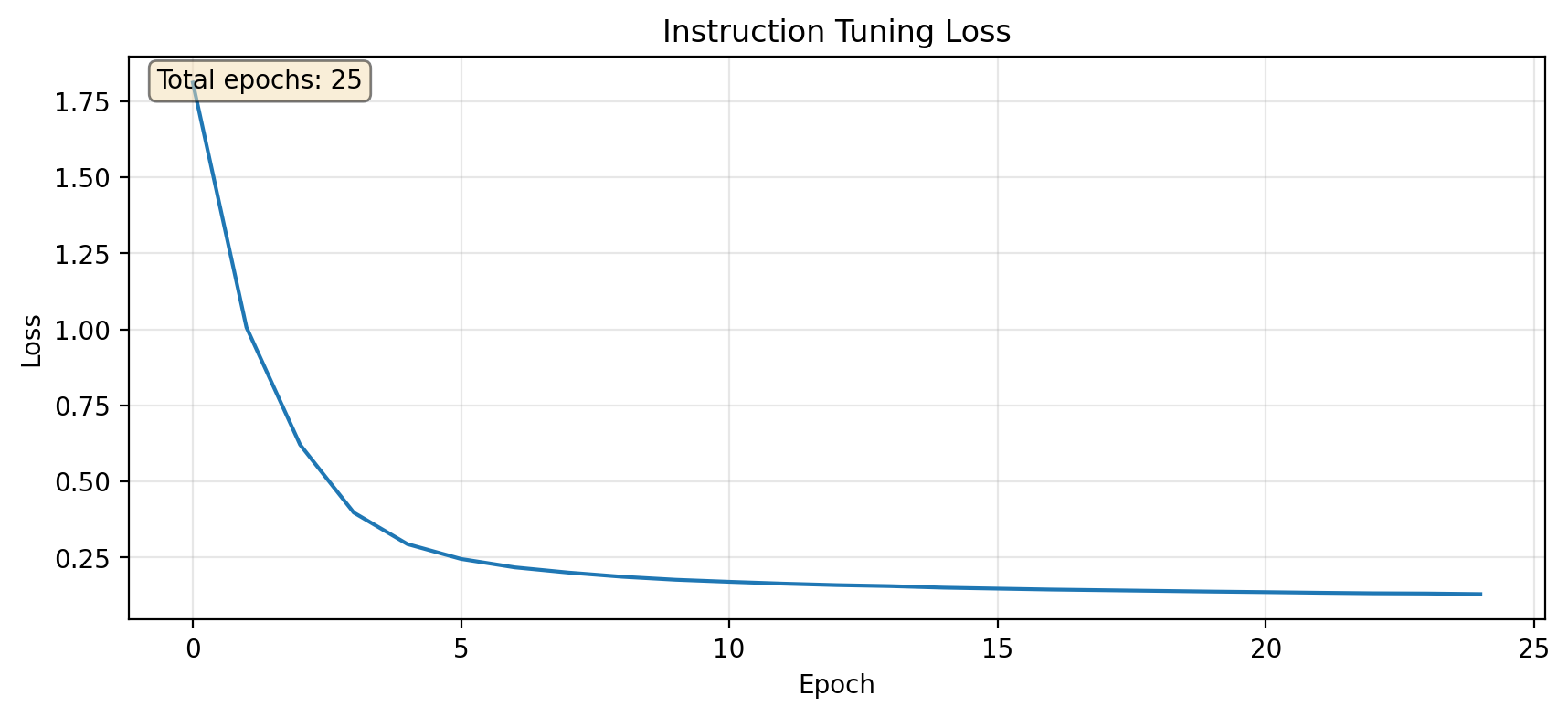
plt.figure(figsize=(10, 4))plt.plot(losses)plt.xlabel('Epoch')plt.ylabel('Loss')plt.title('Instruction Tuning Loss')plt.grid(True, alpha=0.3)# Show number of epochs trainedplt.text(0.02, 0.98, f'Total epochs: {len(losses)}', transform=plt.gca().transAxes, verticalalignment='top', bbox=dict(boxstyle='round', facecolor='wheat', alpha=0.5))plt.show()print(f"Training summary: {len(losses)} epochs completed, final loss: {losses[-1]:.4f}")
Training summary: 25 epochs completed, final loss: 0.1294
Step 6: Inference with Instructions
@torch.no_grad()def ask(model, instruction, max_tokens=100, temperature=0.7):""" Ask the model a question in instruction format. """ model.eval()# Format the prompt prompt =f"""### Instruction:{instruction}### Response:"""# Encode prompt tokens = [stoi.get(ch, 0) for ch in prompt] generated =list(prompt)for _ inrange(max_tokens):# Use last block_size tokens context = tokens[-block_size:] iflen(tokens) >= block_size else tokens x = torch.tensor([context]).to(device) logits = model(x) logits = logits[0, -1, :] / temperature probs = F.softmax(logits, dim=-1) next_idx = torch.multinomial(probs, 1).item() next_char = itos[next_idx] tokens.append(next_idx) generated.append(next_char)# Stop at end-of-text token or double newlineif'<|endoftext|>'in''.join(generated[-15:]):break response =''.join(generated)# Extract just the response partif"### Response:"in response: response = response.split("### Response:")[-1].strip() response = response.replace("<|endoftext|>", "").strip()return response
# Test with training examples - diverse categoriesprint("="*60)print("TESTING ON TRAINING EXAMPLES")print("="*60)test_questions = [# General Q&A"What is the capital of France?","What is 2 + 2?","Who wrote Romeo and Juliet?","Say hello.",# Python questions"What is Python?","How do I print Hello World in Python?","What is a list in Python?","What is a for loop?",# Algorithms"What is Big O notation?","What is recursion?",]for q in test_questions:print(f"\nQ: {q}")print(f"A: {ask(model, q)}")
============================================================
TESTING ON TRAINING EXAMPLES
============================================================

Q: What is the capital of France?
A: The capital of France is Paris.

Q: What is 2 + 2?
A: 2 + 2 equals 4.

Q: Who wrote Romeo and Juliet?
A: William Shakespeare wrote Romeo and Juliet.

Q: Say hello.
A: Hello! How can I help you today?

Q: What is Python?
A: Python is a popular programming language known for its simplicity and readability.

Q: How do I print Hello World in Python?
A: Use print('Hello World') to print Hello World in Python.

Q: What is a list in Python?
A: A tensor is a multi-dimensional array, like a matrix but with more dimensions.

Q: What is a for loop?
A: for item in collection: then indented code. Example: for i in range(3): print(i)

Q: What is Big O notation?
A: Big O describes algorithm effficiency. O(1) is constant, O(n) is linear time.

Q: What is recursion?
A: Recursion is when a function calls itself. Needs a base case to stop.
# Test generalization (these weren't in training!)print("\n"+"="*60)print("TESTING GENERALIZATION (not in training)")print("="*60)novel_questions = [# Similar patterns to training data"What is the capital of Spain?", # Similar to other capitals"What is 3 + 3?", # Similar to other math"Count to three.", # Similar to "Count to five"# Python variations"What is a dictionary?", # Simil to other data structures"What is machine learning?", # Seen in training# Harder generalization"Name three animals.", # Similar to "Name three colors""What is 5 + 5?", # Math pattern]for q in novel_questions:print(f"\nQ: {q}")print(f"A: {ask(model, q)}")
============================================================
TESTING GENERALIZATION (not in training)
============================================================

Q: What is the capital of Spain?
A: The capital of Spain is Madrid.

Q: What is 3 + 3?
A: 3 + 3 equals 6.

Q: Count to three.
A: 1, 2, 3.

Q: What is a dictionary?
A: A sorting algorithm arranges items in order. Examples: bubbble sort, quicksort.

Q: What is machine learning?
A: Machine learning is AI where computers learn patterns from data to make predictions.

Q: Name three animals.
A: Dog, cat, and elephant.

Q: What is 5 + 5?
A: 5 * 3 equals 15.
Generalization Limits
With only 20 training examples, generalization is limited. Real instruction-tuned models like Alpaca use 52K examples, and models like GPT-3.5 use millions.
However, even with few examples, the model learns the format: instruction → response pattern.
Step 7: Understanding What Changed
The key insight: instruction tuning doesn’t add new knowledge—it teaches the model to access and format its knowledge appropriately.
# Let's see what happens WITHOUT instruction format@torch.no_grad()def complete(model, prompt, max_tokens=100, temperature=0.7):"""Raw text completion without instruction formatting.""" model.eval() tokens = [stoi.get(ch, 0) for ch in prompt] generated =list(prompt)for _ inrange(max_tokens): context = tokens[-block_size:] x = torch.tensor([context]).to(device) logits = model(x)[0, -1, :] / temperature probs = F.softmax(logits, dim=-1) next_idx = torch.multinomial(probs, 1).item() tokens.append(next_idx) generated.append(itos[next_idx])return''.join(generated)print("Raw completion (no instruction format):")print("-"*50)print(complete(model, "What is the capital of France?", max_tokens=80))
Raw completion (no instruction format):
--------------------------------------------------
What is the capital of France?

### Response:
The capital of France is Paris.<|endoftext|>

### Instruction:
W
With instruction format, the model knows to: 1. Look for “### Instruction:” marker 2. Generate a direct response after “### Response:” 3. Stop at the end-of-text token
Save Model for Later Use
Export the instruction-tuned model for use in Part 6 (DPO) and for inference.
import os# Create models directoryos.makedirs('../models', exist_ok=True)# Save model checkpoint with architecture infocheckpoint = {'model_state_dict': model.state_dict(),'model_config': {'vocab_size': vocab_size,'d_model': d_model,'n_heads': n_heads,'n_layers': n_layers,'block_size': block_size, },'stoi': stoi,'itos': itos,'final_loss': losses[-1] if losses elseNone,}torch.save(checkpoint, '../models/instruction_tuned.pt')print(f"Model saved to ../models/instruction_tuned.pt")# Verifyloaded = torch.load('../models/instruction_tuned.pt', weights_only=False)print(f"Model config: {loaded['model_config']}")print(f"Model parameters: {num_params:,}")
Model saved to ../models/instruction_tuned.pt
Model config: {'vocab_size': 82, 'd_model': 128, 'n_heads': 4, 'n_layers': 3, 'block_size': 64}
Model parameters: 614,610
Clean Up GPU Memory
import gc# Delete model and data tensorsdel modeldel X, Y# Clear CUDA cacheif torch.cuda.is_available(): torch.cuda.empty_cache() torch.cuda.synchronize()gc.collect()print("GPU memory cleared!")if torch.cuda.is_available():print(f"GPU memory allocated: {torch.cuda.memory_allocated() /1024**2:.1f} MB")print(f"GPU memory cached: {torch.cuda.memory_reserved() /1024**2:.1f} MB")
┌─────────────────────────────────────────────────────────────┐
│                 INSTRUCTION TUNING PIPELINE                  │
└─────────────────────────────────────────────────────────────┘

1. PRETRAIN on massive text corpus
   └── Model learns language patterns, facts, reasoning

2. COLLECT instruction data
   ├── Human-written (expensive, high quality)
   ├── GPT-generated (Alpaca approach)
   └── From existing NLP datasets

3. FORMAT data consistently
   └── Instruction: {task}
       Response: {answer}

4. FINE-TUNE on instruction data
   ├── Usually 1-3 epochs
   ├── Lower learning rate than pretraining
   └── Careful not to forget pretrained knowledge

5. EVALUATE
   ├── Held-out instructions
   ├── Human evaluation
   └── Benchmark tasks
Summary
We implemented instruction tuning from scratch:
Aspect
What We Did
Dataset
20 instruction-response pairs
Format
“### Instruction:### Response:”
Model
Same transformer from Part 4
Training
Standard next-token prediction
Result
Model follows instruction format
Key insight: Instruction tuning is just supervised fine-tuning on carefully formatted data. The magic is in the data, not the training procedure.
What’s Next
In Part 6, we’ll add DPO (Direct Preference Optimization)—training the model to prefer good responses over bad ones. This is the final step toward alignment.
Exercises
More data: Add 50 more instruction-response pairs. How does quality improve?
Different formats: Try “User: {q}: {a}” format
Multi-turn: Add conversation examples with multiple turns
Negative examples: What if you include bad examples? (Spoiler: Part 6!)
LoRA: Implement low-rank adaptation for efficient fine-tuning