import torchimport torch.nn.functional as Ffrom torch import nnimport mathimport osimport matplotlib.pyplot as plttorch.manual_seed(42)device = torch.device("cuda"if torch.cuda.is_available() else"cpu")print(f"Using device: {device}")
Using device: cuda
Step 1: Create a Python Code Dataset
We’ll create a curated dataset of Python code examples covering common patterns.
# Python code examples for trainingpython_code_examples ='''# === BASIC FUNCTIONS ===def hello_world(): """Print hello world.""" print("Hello, World!")def greet(name): """Greet a person by name.""" return f"Hello, {name}!"def add(a, b): """Add two numbers.""" return a + bdef subtract(a, b): """Subtract b from a.""" return a - bdef multiply(a, b): """Multiply two numbers.""" return a * bdef divide(a, b): """Divide a by b.""" if b == 0: raise ValueError("Cannot divide by zero") return a / bdef square(x): """Return square of x.""" return x * xdef cube(x): """Return cube of x.""" return x * x * xdef power(base, exp): """Return base raised to exp.""" return base ** expdef absolute(x): """Return absolute value.""" if x < 0: return -x return x# === LIST OPERATIONS ===def sum_list(numbers): """Sum all numbers in a list.""" total = 0 for num in numbers: total += num return totaldef average(numbers): """Calculate average of numbers.""" if len(numbers) == 0: return 0 return sum(numbers) / len(numbers)def find_max(numbers): """Find maximum value in list.""" if len(numbers) == 0: return None max_val = numbers[0] for num in numbers: if num > max_val: max_val = num return max_valdef find_min(numbers): """Find minimum value in list.""" if len(numbers) == 0: return None min_val = numbers[0] for num in numbers: if num < min_val: min_val = num return min_valdef reverse_list(items): """Reverse a list.""" return items[::-1]def count_items(items): """Count items in list.""" return len(items)def first_element(items): """Get first element.""" if len(items) == 0: return None return items[0]def last_element(items): """Get last element.""" if len(items) == 0: return None return items[-1]def remove_duplicates(items): """Remove duplicates from list.""" return list(set(items))def flatten(nested_list): """Flatten a nested list.""" result = [] for item in nested_list: if isinstance(item, list): result.extend(flatten(item)) else: result.append(item) return result# === STRING OPERATIONS ===def reverse_string(s): """Reverse a string.""" return s[::-1]def is_palindrome(s): """Check if string is palindrome.""" s = s.lower() return s == s[::-1]def count_vowels(s): """Count vowels in string.""" vowels = "aeiouAEIOU" count = 0 for char in s: if char in vowels: count += 1 return countdef count_words(s): """Count words in string.""" words = s.split() return len(words)def to_uppercase(s): """Convert to uppercase.""" return s.upper()def to_lowercase(s): """Convert to lowercase.""" return s.lower()def capitalize_words(s): """Capitalize each word.""" return s.title()def remove_spaces(s): """Remove all spaces.""" return s.replace(" ", "")def replace_char(s, old, new): """Replace character in string.""" return s.replace(old, new)# === NUMBER CHECKS ===def is_even(n): """Check if number is even.""" return n % 2 == 0def is_odd(n): """Check if number is odd.""" return n % 2 != 0def is_positive(n): """Check if number is positive.""" return n > 0def is_negative(n): """Check if number is negative.""" return n < 0def is_prime(n): """Check if number is prime.""" if n < 2: return False for i in range(2, int(n**0.5) + 1): if n % i == 0: return False return Truedef is_perfect_square(n): """Check if n is perfect square.""" if n < 0: return False root = int(n**0.5) return root * root == n# === CLASSIC ALGORITHMS ===def factorial(n): """Calculate factorial of n.""" if n <= 1: return 1 return n * factorial(n - 1)def fibonacci(n): """Return nth Fibonacci number.""" if n <= 0: return 0 if n == 1: return 1 return fibonacci(n-1) + fibonacci(n-2)def fibonacci_list(n): """Return first n Fibonacci numbers.""" if n <= 0: return [] if n == 1: return [0] fibs = [0, 1] for i in range(2, n): fibs.append(fibs[-1] + fibs[-2]) return fibsdef gcd(a, b): """Find greatest common divisor.""" while b: a, b = b, a % b return adef lcm(a, b): """Find least common multiple.""" return a * b // gcd(a, b)def binary_search(arr, target): """Binary search for target in sorted array.""" left, right = 0, len(arr) - 1 while left <= right: mid = (left + right) // 2 if arr[mid] == target: return mid elif arr[mid] < target: left = mid + 1 else: right = mid - 1 return -1def bubble_sort(arr): """Sort array using bubble sort.""" n = len(arr) for i in range(n): for j in range(0, n-i-1): if arr[j] > arr[j+1]: arr[j], arr[j+1] = arr[j+1], arr[j] return arrdef insertion_sort(arr): """Sort array using insertion sort.""" for i in range(1, len(arr)): key = arr[i] j = i - 1 while j >= 0 and arr[j] > key: arr[j + 1] = arr[j] j -= 1 arr[j + 1] = key return arrdef linear_search(arr, target): """Linear search for target.""" for i, val in enumerate(arr): if val == target: return i return -1# === DATA STRUCTURES ===class Stack: """Stack data structure.""" def __init__(self): self.items = [] def push(self, item): self.items.append(item) def pop(self): if self.is_empty(): return None return self.items.pop() def peek(self): if self.is_empty(): return None return self.items[-1] def is_empty(self): return len(self.items) == 0 def size(self): return len(self.items)class Queue: """Queue data structure.""" def __init__(self): self.items = [] def enqueue(self, item): self.items.append(item) def dequeue(self): if self.is_empty(): return None return self.items.pop(0) def front(self): if self.is_empty(): return None return self.items[0] def is_empty(self): return len(self.items) == 0 def size(self): return len(self.items)class Node: """Node for linked list.""" def __init__(self, data): self.data = data self.next = Noneclass LinkedList: """Singly linked list.""" def __init__(self): self.head = None def append(self, data): new_node = Node(data) if not self.head: self.head = new_node return current = self.head while current.next: current = current.next current.next = new_node def prepend(self, data): new_node = Node(data) new_node.next = self.head self.head = new_node def delete(self, data): if not self.head: return if self.head.data == data: self.head = self.head.next return current = self.head while current.next: if current.next.data == data: current.next = current.next.next return current = current.next def find(self, data): current = self.head while current: if current.data == data: return True current = current.next return False# === FILE OPERATIONS ===def read_file(filename): """Read contents of a file.""" with open(filename, 'r') as f: return f.read()def write_file(filename, content): """Write content to a file.""" with open(filename, 'w') as f: f.write(content)def append_file(filename, content): """Append content to a file.""" with open(filename, 'a') as f: f.write(content)def read_lines(filename): """Read file as list of lines.""" with open(filename, 'r') as f: return f.readlines()def count_lines(filename): """Count lines in a file.""" with open(filename, 'r') as f: return len(f.readlines())# === DICTIONARY OPERATIONS ===def merge_dicts(dict1, dict2): """Merge two dictionaries.""" result = dict1.copy() result.update(dict2) return resultdef get_keys(d): """Get all keys from dictionary.""" return list(d.keys())def get_values(d): """Get all values from dictionary.""" return list(d.values())def invert_dict(d): """Swap keys and values.""" return {v: k for k, v in d.items()}def filter_dict(d, keys): """Filter dictionary by keys.""" return {k: v for k, v in d.items() if k in keys}# === LIST COMPREHENSIONS ===def squares(n): """Return squares from 1 to n.""" return [x**2 for x in range(1, n+1)]def evens(n): """Return even numbers up to n.""" return [x for x in range(n+1) if x % 2 == 0]def odds(n): """Return odd numbers up to n.""" return [x for x in range(n+1) if x % 2 != 0]def filter_positive(numbers): """Filter positive numbers.""" return [x for x in numbers if x > 0]def double_all(numbers): """Double all numbers.""" return [x * 2 for x in numbers]# === ERROR HANDLING ===def safe_divide(a, b): """Safely divide with error handling.""" try: return a / b except ZeroDivisionError: return Nonedef safe_int(s): """Safely convert string to int.""" try: return int(s) except ValueError: return Nonedef safe_get(lst, index): """Safely get list element.""" try: return lst[index] except IndexError: return None# === DECORATORS ===def timer(func): """Decorator to time function.""" import time def wrapper(*args, **kwargs): start = time.time() result = func(*args, **kwargs) end = time.time() print(f"{func.__name__} took {end-start:.4f}s") return result return wrapperdef memoize(func): """Decorator for memoization.""" cache = {} def wrapper(*args): if args not in cache: cache[args] = func(*args) return cache[args] return wrapper# === GENERATORS ===def range_generator(n): """Generate numbers 0 to n-1.""" i = 0 while i < n: yield i i += 1def infinite_counter(): """Infinite counter generator.""" n = 0 while True: yield n n += 1def fibonacci_generator(): """Generate Fibonacci numbers.""" a, b = 0, 1 while True: yield a a, b = b, a + b'''print(f"Training data: {len(python_code_examples):,} characters")print(f"Approximate lines: {python_code_examples.count(chr(10))}")
Training data: 10,927 characters
Approximate lines: 509
Step 2: Build Vocabulary
# Build character vocabulary from codechars =sorted(set(python_code_examples))stoi = {ch: i for i, ch inenumerate(chars)}itos = {i: ch for ch, i in stoi.items()}vocab_size =len(stoi)print(f"Vocabulary size: {vocab_size}")print(f"Characters include: letters, digits, punctuation, whitespace")print(f"\nSample characters: {repr(''.join(chars[:30]))}")
# Create model - REDUCED size for fast demod_model =128# Reduced from 256n_heads =4# Reduced from 8n_layers =3# Reduced from 6model = CodeLM( vocab_size=vocab_size, d_model=d_model, n_heads=n_heads, n_layers=n_layers, block_size=block_size, dropout=0.1).to(device)num_params =sum(p.numel() for p in model.parameters())print(f"Model parameters: {num_params:,}")# Model scale contextprint(f"\n--- Model Scale Context ---")print(f"Our model: ~{num_params/1_000_000:.1f}M parameters (SMALL for fast demo!)")print(f"CodeLlama-7B: 7B parameters ({7_000_000_000/num_params:.0f}x larger)")print(f"GPT-4: ~1T+ parameters ({1_000_000_000_000/num_params:.0f}x larger)")
Model parameters: 613,839

--- Model Scale Context ---
Our model:     ~0.6M parameters (SMALL for fast demo!)
CodeLlama-7B:  7B parameters   (11404x larger)
GPT-4:         ~1T+ parameters (1629092x larger)
Step 5: Training
def train(model, X, Y, epochs=1000, batch_size=32, lr=3e-4, checkpoint_path='../models/checkpoint_part7.pt', resume=True):""" Resumable training with checkpoint saving. """ model.train() optimizer = torch.optim.AdamW(model.parameters(), lr=lr) scheduler = torch.optim.lr_scheduler.CosineAnnealingLR(optimizer, epochs) X, Y = X.to(device), Y.to(device) losses = [] start_epoch =0# Try to resume from checkpointif resume and os.path.exists(checkpoint_path):print(f"Resuming from checkpoint: {checkpoint_path}") checkpoint = torch.load(checkpoint_path, weights_only=False) model.load_state_dict(checkpoint['model_state_dict']) optimizer.load_state_dict(checkpoint['optimizer_state_dict']) scheduler.load_state_dict(checkpoint['scheduler_state_dict']) start_epoch = checkpoint['epoch'] +1 losses = checkpoint['losses']print(f"Resumed from epoch {start_epoch}, previous loss: {losses[-1]:.4f}")for epoch inrange(start_epoch, epochs): perm = torch.randperm(X.shape[0]) total_loss, n_batches =0, 0for i inrange(0, len(X), batch_size): idx = perm[i:i+batch_size] x_batch, y_batch = X[idx], Y[idx] logits = model(x_batch) loss = F.cross_entropy(logits.view(-1, vocab_size), y_batch.view(-1)) optimizer.zero_grad() loss.backward() torch.nn.utils.clip_grad_norm_(model.parameters(), 1.0) optimizer.step() total_loss += loss.item() n_batches +=1 scheduler.step() losses.append(total_loss / n_batches)if epoch %50==0:print(f"Epoch {epoch}: Loss = {losses[-1]:.4f}")# Save checkpoint every 25 epochsif (epoch +1) %25==0: os.makedirs(os.path.dirname(checkpoint_path), exist_ok=True) torch.save({'epoch': epoch,'model_state_dict': model.state_dict(),'optimizer_state_dict': optimizer.state_dict(),'scheduler_state_dict': scheduler.state_dict(),'losses': losses, }, checkpoint_path)print(f"Training complete! Final loss: {losses[-1]:.4f}")return losses# Educational note: 150 epochs on small model for fast demo# For production: larger model and 1000+ epochs# Training is resumable - interrupt and re-run this cell to continue!print("Training on Python code (resumable)...")losses = train(model, X, Y, epochs=150, batch_size=64, lr=3e-4)
Training on Python code (resumable)...
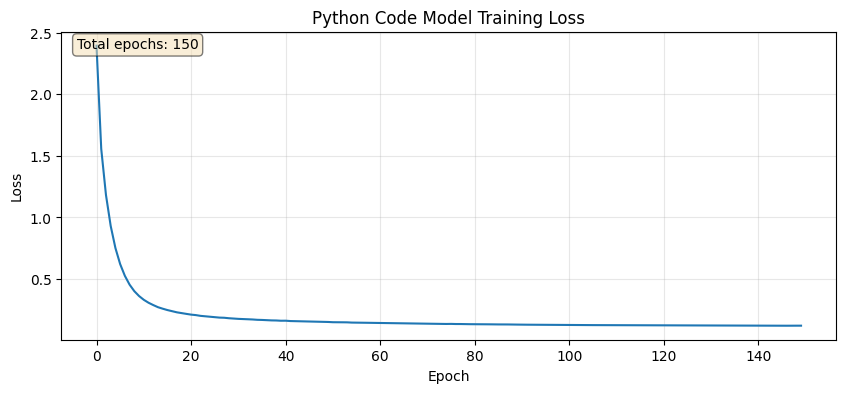
Epoch 0: Loss = 2.3946
Epoch 50: Loss = 0.1488
Epoch 100: Loss = 0.1262
Training complete! Final loss: 0.1207
plt.figure(figsize=(10, 4))plt.plot(losses)plt.xlabel('Epoch')plt.ylabel('Loss')plt.title('Python Code Model Training Loss')plt.grid(True, alpha=0.3)# Show number of epochs trainedplt.text(0.02, 0.98, f'Total epochs: {len(losses)}', transform=plt.gca().transAxes, verticalalignment='top', bbox=dict(boxstyle='round', facecolor='wheat', alpha=0.5))plt.show()print(f"Training summary: {len(losses)} epochs completed, final loss: {losses[-1]:.4f}")
Training summary: 150 epochs completed, final loss: 0.1207
Step 6: Code Generation!
@torch.no_grad()def generate_code(model, prompt, max_tokens=200, temperature=0.8):"""Generate Python code from a prompt.""" model.eval() tokens = [stoi.get(ch, 0) for ch in prompt] generated =list(prompt)for _ inrange(max_tokens): context = tokens[-block_size:] iflen(tokens) >= block_size else tokens x = torch.tensor([context]).to(device) logits = model(x)[0, -1, :] / temperature probs = F.softmax(logits, dim=-1) next_idx = torch.multinomial(probs, 1).item() tokens.append(next_idx) generated.append(itos[next_idx])# Stop at double newline (end of function)if''.join(generated[-3:]) =='\n\n\n':breakreturn''.join(generated)
============================================================
CODE COMPLETION EXAMPLES
============================================================

--- Prompt: ---
def is_even(n):
    """
--- Generated: ---
def is_even(n):
    """Check if number is even."""
    return n % 2 == 0

def is_odd(n):
    """Check if number is odd."""
    return n % 2 != 0

def is_positive(n):
    """


--- Prompt: ---
def factorial(n):
    """
--- Generated: ---
def factorial(n):
    """Calculate factorial of n."""
    if n <= 1:
        return 1
    return n * factorial(n - 1)

def fibonacci(n):
    """Return nth Fibonacci number."""


--- Prompt: ---
def reverse_string(s):
    """
--- Generated: ---
def reverse_string(s):
    """Reverse a string."""
    return s[::-1]

def is_palindrome(s):
    """Check if string is palindrome."""
    s = s.lower()
    return s == s[::-1]

def


--- Prompt: ---
def find_max(numbers):
    """
--- Generated: ---
def find_max(numbers):
    """Find maximum value in list."""
    if len(numbers) == 0:
        return None
    min_val = numbers[0]
    for num in numbers:
        if num < min_val


--- Prompt: ---
class Stack:
    """
--- Generated: ---
class Stack:
    """Stack data structure."""
    def __init__(self):
        self.items = []

    def enqueue(self, item):
        self.items.append(item)

    def pop(se
# Generate from function signatureprint("="*60)print("GENERATING FROM SIGNATURES")print("="*60)signatures = ['def add(a, b):','def is_prime(n):','def sum_list(numbers):','def binary_search(arr, target):',]for sig in signatures:print(f"\n{sig}") result = generate_code(model, sig +'\n', max_tokens=200, temperature=0.6)print(result)
============================================================
GENERATING FROM SIGNATURES
============================================================

def add(a, b):
def add(a, b):
    """Add two numbers."""
    return a + b

def subtract(a, b):
    """Subtract b from a."""
    return a - b

def multiply(a, b):
    """Multiply two numbers."""
    return a * b

def divide(a, b):


def is_prime(n):
def is_prime(n):
    """Check if number is prime."""
    if n < 2:
        return False
    for i in range(2, int(n**0.5) + 1):
        if n % i == 0:
            return False
    return True

def is_perfect_square(n)

def sum_list(numbers):
def sum_list(numbers):
    """Sum all numbers in a list."""
    total = 0
    for num in numbers:
        total += num
    return total

def average(numbers):
    """Calculate average of numbers."""
    if len(numbers) == 0

def binary_search(arr, target):
def binary_search(arr, target):
    """Binary search for target in sorted array."""
    left, right = 0, len(arr) - 1
    while left <= right:
        mid = (left + right) // 2
        if arr[mid] == target:
            return mid
Step 7: Testing Generated Code
The amazing thing about code generation is we can actually test if the code works!
def test_generated_code(model, function_name, test_cases, temperature=0.6):""" Generate a function and test it. Args: function_name: Name of function to generate test_cases: List of (input, expected_output) tuples """# Generate the function prompt =f"def {function_name}" generated = generate_code(model, prompt, max_tokens=200, temperature=temperature)print(f"Generated code:")print("-"*40)print(generated)print("-"*40)# Try to execute ittry:exec(generated, globals())print("Code executed successfully!")# Run test cases func =eval(function_name.split('(')[0]) passed =0for inputs, expected in test_cases:try:ifisinstance(inputs, tuple): result = func(*inputs)else: result = func(inputs)if result == expected:print(f" PASS: {function_name.split('(')[0]}({inputs}) = {result}") passed +=1else:print(f" FAIL: {function_name.split('(')[0]}({inputs}) = {result}, expected {expected}")exceptExceptionas e:print(f" ERROR: {e}")print(f"\nPassed {passed}/{len(test_cases)} tests")exceptSyntaxErroras e:print(f"Syntax error: {e}")exceptExceptionas e:print(f"Error: {e}")
============================================================
TESTING: reverse_string
============================================================
Generated code:
----------------------------------------
def reverse_string(s):
    """Reverse a string."""
    return s[::-1]

def is_palindrome(s):
    """Check if string is palindrome."""
    s = s.lower()
    return s == s[::-1]

def count_vowels(s):
    """Count vowels in s
----------------------------------------
Syntax error: unterminated triple-quoted string literal (detected at line 11) (<string>, line 11)
Step 8: Code Understanding - Fill in the Blank
# Can the model complete partial code?print("="*60)print("FILL IN THE BLANK")print("="*60)partial_code = ["for i in range(10):\n print(","if x > 0:\n return ","numbers = [1, 2, 3]\ntotal = sum(","with open('file.txt', '",]for code in partial_code:print(f"\nInput: {repr(code)}") result = generate_code(model, code, max_tokens=20, temperature=0.5)# Show just the completion completion = result[len(code):].split('\n')[0]print(f"Completion: {repr(completion)}")
============================================================
FILL IN THE BLANK
============================================================

Input: 'for i in range(10):\n    print('
Completion: '""Hello, World!")'

Input: 'if x > 0:\n    return '
Completion: '0'

Input: 'numbers = [1, 2, 3]\ntotal = sum('
Completion: 'numbers):'

Input: "with open('file.txt', '"
Completion: "w') as f:"
Save Model
# Create models directoryos.makedirs('../models', exist_ok=True)# Save model checkpointcheckpoint = {'model_state_dict': model.state_dict(),'model_config': {'vocab_size': vocab_size,'d_model': d_model,'n_heads': n_heads,'n_layers': n_layers,'block_size': block_size, },'stoi': stoi,'itos': itos,'final_loss': losses[-1] if losses elseNone,}torch.save(checkpoint, '../models/python_code_lm.pt')print(f"Model saved to ../models/python_code_lm.pt")print(f"Model parameters: {num_params:,}")
Model saved to ../models/python_code_lm.pt
Model parameters: 613,839